
han being limited to answering questions from a static knowledge base. Internal operations is another strong fit - agents that can pull data from multiple internal systems, compile a report, flag anomalies, and route it to the right person, work that previously consumed hours of a skilled employee's time on largely repetitive assembly.
Data analysis workflows are seeing similar gains, with agents capable of taking a broad business question, figuring out which data sources are relevant, running the necessary queries, and presenting findings in a readable format, compressing work that used to require a dedicated analyst's afternoon into a much shorter cycle. None of these use cases eliminate the need for human judgment, but they meaningfully change how much routine, multi-step work needs a person driving every individual action.
Giving an AI system the ability to take actions rather than just generate text raises the stakes considerably if something goes wrong. A chatbot that gives a slightly wrong answer is an annoyance; an agent that takes an incorrect action, like issuing a refund it shouldn't have or sending an email to the wrong recipient, is a different category of problem entirely. This is why serious agentic AI deployments build in explicit boundaries around what an agent is allowed to do autonomously versus what requires human approval before execution.
Businesses adopting agentic AI need clear answers to a few governance questions before deployment: what is the maximum financial or operational impact an agent can have without a human sign-off, how are the agent's actions logged so they can be reviewed after the fact, and what happens when the agent encounters a situation genuinely outside its training or instructions. Skipping this groundwork in the rush to deploy is where most agentic AI horror stories originate.

There's a tendency to think of human oversight as a temporary training-wheels phase that gets removed once an agent proves itself. In practice, thoughtful human-in-the-loop design tends to be a permanent, deliberate architectural choice rather than a phase to graduate out of, particularly for any action with real financial, legal, or customer-relationship consequences. The most successful agentic deployments tend to draw a clear, sensible line: routine, low-risk, easily reversible actions get full autonomy, while higher-stakes actions route through a fast human approval step that still saves enormous time compared to a person doing the entire task manually.
This design also builds trust internally. Employees and leadership are far more willing to expand what an agent is allowed to do once they've seen it operate reliably within a bounded, reviewable scope, rather than being asked to trust an unbounded system from day one.
For Indian businesses specifically, a few practical considerations sit alongside the general governance questions. Data residency and privacy obligations apply just as much to data an agent accesses and processes as to data a human employee handles, so the underlying infrastructure and any third-party AI tools involved need the same scrutiny as any other system touching customer data. Integration complexity is often underestimated too - an agent is only as capable as the systems it can actually connect to, and businesses running older, poorly documented internal software sometimes find that the integration work, not the AI itself, is the larger project.
Cost structure is also worth understanding upfront, since agentic systems that make multiple tool calls and reasoning steps per task can have meaningfully different cost profiles than a simple chatbot interaction, and businesses should model this against the labor time actually being saved rather than assuming it's automatically cheaper.
The technical rollout of an agentic system is often the easier half of the project. The harder half is helping a team adjust to working alongside a system that can independently complete tasks they used to own end-to-end. Employees sometimes read agent adoption as a signal their role is being phased out, which breeds quiet resistance, underreporting of the agent's mistakes, or reluctance to hand over tasks even when doing so would clearly save time. Addressing this openly, framing the agent as handling the repetitive assembly work so people can spend more time on judgment calls and exceptions, tends to produce far smoother adoption than rolling out the technology and hoping the cultural adjustment sorts itself out.
It also helps to involve the employees closest to a workflow in defining what the agent should and shouldn't be allowed to do autonomously. They usually know the edge cases and awkward exceptions that don't show up in a clean process diagram, and building the agent's boundaries around that frontline knowledge produces a system that fits how the work actually happens rather than how it looks on paper.

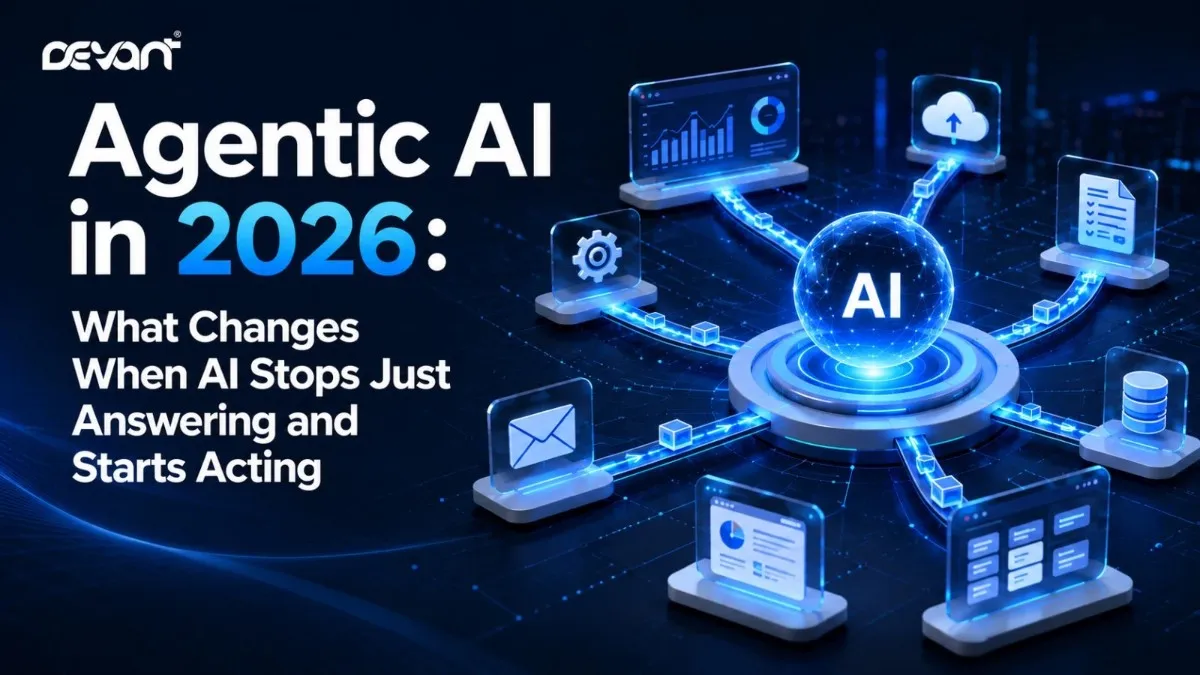
A chatbot answers a single question in one exchange. An agent is given a broader goal and can plan and execute a sequence of steps, using tools and other systems along the way, to complete a task with limited manual intervention.
It can be, because an agent takes actions rather than just generating text, so a mistake has real operational consequences. This is why deliberate governance and clear boundaries on autonomous action are essential before deployment.
Not in well-designed systems. Thoughtful human-in-the-loop design, where higher-stakes actions require human approval, tends to be a permanent architectural choice rather than a temporary phase.
Integration complexity is often underestimated. An agent can only act on systems it can actually connect to, and older or poorly documented internal software can make integration a larger project than the AI component itself.
Devant IT Solutions focuses on clear governance boundaries, logging, and human-in-the-loop review from the start, integrating carefully with a business's actual internal systems rather than deploying a generic, one-size-fits-all agent.
Agentic AI represents a genuine shift in what automation can take on, but the businesses that get real value from it are the ones treating governance and integration as seriously as the AI capability itself. Adopted thoughtfully, it can meaningfully reduce the routine, multi-step work that quietly consumes so much of a team's time.
Get In Touch If your business is exploring where agentic AI could fit into your operations, Devant IT Solutions can help evaluate the opportunity and build a system designed for real-world reliability.
Connect with Devant IT Solutions to start the conversation, or follow us on our social channels for more insights on AI and digital transformation.