A common pattern: solid product, reliable team, real customers - yet growth has stalled. Revenue plateaus, margins thin, and the team works harder with diminishing returns. Leadership keeps asking the same question: what are we missing? The answer is rarely more people or more spending. It's operational intelligence - built when the right technology is woven into how a business actually runs. Your most agile competitors are already automating manual tasks, making faster decisions, and scaling into new markets without adding overhead. The difference is simple: they aligned their technology strategy with their growth ambitions.
Business growth in 2026 is no longer about grinding harder - it's about building smarter systems that work on your behalf. With the right IT infrastructure, tools, and strategy, businesses can unlock capacity, accelerate decisions, and scale without proportionally increasing costs. That's where partners like Devant IT Solutions make the difference — translating IT strategy into real, measurable growth. This guide breaks down exactly how IT innovation drives sustainable growth, with grounded analysis and actionable direction you can apply today.
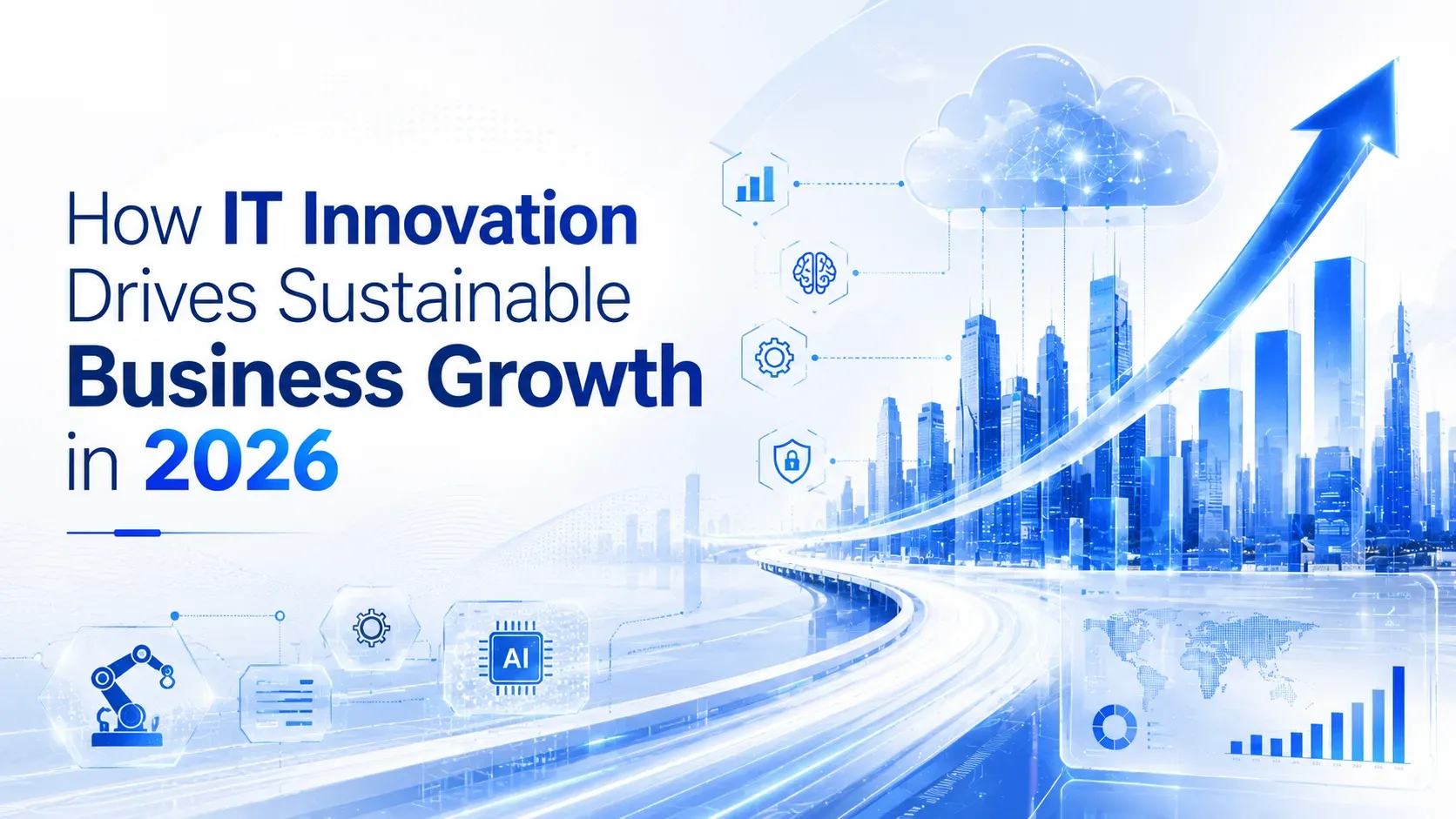
Growth was once measured simply: more customers, more revenue, more employees. In 2026, that definition has expanded. Growth now means operational efficiency, faster decision-making, better customer experience, and organisational resilience - and technology is the force driving this shift. Cloud infrastructure lets businesses scale in real time. AI-powered analytics forecast customer behaviour before competitors spot the trend. Automation frees people from repetitive tasks to focus on work that actually moves the needle.
The data backs this up consistently - businesses that prioritise technology in their operations outperform peers across every key metric: revenue, margin, retention, and market share. That's not a coincidence. It's the compounding effect of operational advantage, built over time by organisations that made technology a core part of how they run, not an add-on to how they operate. This is what modern business growth looks like when technology is genuinely embedded into your strategy.
Traditional decision-making relied on quarterly reports, gut instinct, and management consensus. Today, data analytics platforms deliver real-time visibility into sales pipelines, customer sentiment, inventory levels, and operational performance , all from a single dashboard. Businesses that adopt data-driven cultures respond to market changes in hours, not months. The ones that do not are constantly playing catch-up.
Growth used to mean hiring more people for every new function. Cloud computing broke that equation entirely. A business can now serve ten times the customer volume with the same core team, because cloud-based systems handle the processing, storage, and delivery at scale. This is not a theoretical benefit - it is the operating model of the fastest-growing businesses across every sector in 2026.
AI-powered CRM systems, personalisation engines, and intelligent virtual assistants have raised the bar for what customers expect. Businesses that use technology to anticipate customer needs - not just react to them - consistently outperform those that do not. In 2026, customer experience is a direct business growth lever, and IT is the mechanism that makes it possible at scale.
The following pillars represent the specific ways that technology investment translates into measurable business growth - not theoretically, but in real operational terms that your business can act on today.
Business process automation is one of the highest-ROI investments a growing company can make. Automating repetitive tasks - data entry, invoicing, scheduling, reporting - drives two simultaneous outcomes: costs drop as labour shifts to higher-value work, and accuracy improves as human error is eliminated. The numbers back this up: businesses that automate lead generation and sales workflows cut customer acquisition costs by up to 40% and improve sales cycle times by around 25%. These gains compound quarter after quarter, stretching budgets further and widening the gap between those who automate and those who don't.
But automation isn't about replacing people - it's about elevating them. When finance teams stop doing manual reconciliation, they become strategic analysts. When sales teams stop logging data, they close more deals. The shift in what a team can accomplish - with the same headcount, in the same hours - is one of the most underestimated growth levers available to businesses today. The goal isn't fewer people. It's better work from every person you already have.

Cloud migration remains one of the most powerful growth enablers for businesses of any size. The model is simple: access computing power on demand, pay for what you use, scale when needed, and never worry about obsolete hardware. For growing businesses, this fundamentally changes the economics of expansion - enter new markets without waiting on infrastructure procurement , handle traffic surges without downtime, and support distributed teams without sacrificing security or performance. The barrier between ambition and execution gets significantly smaller.
In 2026, leading businesses are moving beyond basic cloud-first models toward hybrid architectures - combining cloud elasticity for variable workloads, on-premise stability for sensitive data, and edge computing for real-time processing needs. This isn't complexity for its own sake. It's precision-engineered infrastructure built to match the specific demands of a scaling business - giving organisations the flexibility to grow fast without the technical debt that unplanned expansion typically leaves behind.
Data is the raw material of modern business growth - but without the right tools, it's just noise. Analytics platforms transform operational data into actionable intelligence: customer behaviour patterns, supply chain inefficiencies, and emerging market opportunities that would otherwise go unnoticed. In 2026, AI integration makes this even more powerful. Instead of waiting on manual reports, AI-driven platforms surface insights automatically and in real time - marketing spots an underperforming campaign before it burns budget, operations sees a bottleneck before it causes delays, and leadership allocates resources based on forecasts, not instinct.
The competitive gap this creates is significant and growing. Most senior executives now expect AI-driven analytics to become a primary revenue driver in the coming years, and the distance between businesses that have embedded data intelligence and those that haven't is widening every quarter. This isn't just a technology decision - it's a growth decision. Businesses that treat data as a strategic asset, rather than a byproduct of operations, are the ones that will outpace, outmanoeuvre, and outlast the competition
Cybersecurity rarely tops the growth conversation - but it should. Every digital capability your business builds depends entirely on the security of the systems running it. A single breach can destroy years of customer trust. Non-compliance can trigger penalties that dwarf your IT budget. Even a few hours of downtime carries a direct, measurable revenue impact. In a business environment where digital operations are the backbone of growth, security isn't a supporting function - it's a foundational one.
More importantly, strong cybersecurity is a genuine competitive differentiator. In data-sensitive industries - finance, healthcare, legal, professional services - mature security practices are a selling point that opens doors and closes deals. Enterprise clients audit it. Investors evaluate it. Regulators require it. Businesses that treat cybersecurity as an afterthought aren't just exposed to risk - they're quietly placing a ceiling on their own growth potential. In 2026, security is a commercial capability, not an IT overhead, and the businesses that recognise this early will carry a significant advantage.
Artificial intelligence has moved well beyond being a futuristic concept. It is now a practical, proven driver of customer revenue. AI enables businesses to personalise experiences at scale - something that was previously only possible with large customer-facing teams. It powers virtual assistants that handle thousands of inquiries simultaneously. It drives recommendation engines that increase average order value. It enables predictive service that resolves issues before customers ever complain.
The business impact is concrete and growing. Businesses that have integrated AI into customer-facing operations report not just satisfaction improvements but measurable increases in repeat purchase rates, customer lifetime value, and organic referral growth. And with AI costs continuing to decline rapidly, the return on investment is becoming compelling for businesses of every size - not just enterprise.
If cloud computing changed the economics of scale, agentic AI is changing the economics of intelligence. In 2026, the defining shift isn't AI as a feature - it's AI as an autonomous operator that takes a goal, plans execution, and delivers outcomes independently. Unlike chatbots or simple workflow triggers, AI agents interpret instructions, break them into steps, execute across multiple platforms, and produce results without constant human input. A sales agent can qualify leads, draft outreach, schedule follow-ups, and escalate to a human only when a deal is close - all without anyone manually initiating the process.
What makes this truly powerful is not just the speed, but the intelligence behind it. Agents handle ambiguity, adapt to new information, and navigate complex workflows that once required human judgment - without breaks, missed notifications, or onboarding time. But the businesses seeing the greatest results didn't simply automate what already existed - they redesigned their processes first. Technology amplifies what's already there, so if the foundation is broken, automation just breaks it faster. Multi-agent systems, where multiple AI agents collaborate and hand off to humans only when necessary, are rapidly becoming mainstream - and the businesses piloting them today are quietly building the competitive edge that will define market positioning for years to come.
Understanding how IT innovation enables business growth is valuable. Seeing it play out in real business scenarios is what makes it actionable. The following represent the types of challenges and outcomes we encounter regularly in our work with clients.

A mid-sized professional services firm was managing leads through spreadsheets, with follow-ups entirely dependent on individual salespeople remembering to act. Leadership had no pipeline visibility and no way to understand why promising leads went cold. After implementing a cloud-based CRM with automated lead scoring and follow-up sequences, everything changed. Leads were scored automatically, follow-up actions triggered without human input, and sales managers gained real-time pipeline visibility without pulling a single report. Within two quarters, sales revenue rose 29% and team productivity improved by 34% - not by working harder, but by letting the system work smarter.
This is not an isolated result. Industry research confirms that businesses using CRM tools see conversion rates improve significantly - in some studies by as much as 300% - alongside measurable gains in retention, forecasting accuracy, and sales cycle efficiency. The firm didn't hire more salespeople or increase its marketing budget. It simply gave its existing team the right system to work within, and the results compounded from there. A well-implemented CRM consistently delivers some of the most reliable ROI in enterprise technology - and for growing businesses, it is often the single highest-impact place to start.
A growing e-commerce business was handling order processing, inventory updates, and customer notifications entirely by hand. As order volume scaled, so did errors and delays - customer satisfaction scores were falling even as the business expanded. After automating their core operational workflows, the bottlenecks disappeared. Inventory updated in real time, customers received automatic order notifications, and service escalations were routed intelligently by issue type and priority. Manual workload dropped by 40%, error rates reached near zero, and customer satisfaction recovered within a single quarter - without adding a single new team member.
The broader lesson here goes beyond efficiency. Capacity recovered from repetitive tasks isn't just a cost saving - it gets redeployed into work that actually drives growth. Sales outreach increases, product development accelerates, and customer relationships deepen. Automation didn't shrink this team; it freed them to focus on the work that a system simply cannot do. That shift - from reactive and manual to proactive and strategic - is what separates businesses that merely survive scaling from those that genuinely thrive through it.
A regional technology company was running on ageing on-premise servers that demanded constant maintenance and kept their IT team focused entirely on keeping existing systems alive. Every new client triggered an infrastructure conversation that slowed the sales cycle and frustrated prospects - growth was happening, but the foundations weren't built to support it. After migrating to a hybrid cloud architecture, that changed entirely. Infrastructure costs dropped, new clients were onboarded in days instead of weeks, and the IT team shifted from reactive maintenance to strategic projects that directly supported product development and client outcomes.
But the biggest win wasn't the cost saving - it was removing the ceiling on growth. The business could now scale as fast as its sales team could sell, with infrastructure no longer acting as a bottleneck. That is what cloud migration delivers at its best: not just lower costs, but higher velocity. When technology stops being the reason growth slows down and starts being the reason growth speeds up, the entire trajectory of a business changes. This company didn't just modernise its infrastructure - it unlocked a faster, more scalable version of itself.
The businesses growing strongest in 2026 share one trait: IT strategy is a core pillar of how they plan, operate, and compete -- not an afterthought. They invest in technology that solves specific problems and delivers measurable outcomes, not technology for the sake of appearing innovative. Building a growth-ready IT strategy starts with honesty about where you are today. Where are processes most manual and error-prone? Where is data siloed? Where does your team spend hours on tasks a well-configured system could handle? Those answers are your roadmap - a prioritised list of operational improvements with clear business impact, not a technology wishlist. From there, prioritise carefully: cloud migration, CRM implementation, and core process automation typically deliver fast, measurable ROI and build the foundation that more advanced capabilities like AI and agentic workflows require to add value.
But the step most businesses underestimate is execution. Technology alone delivers only a fraction of any transformation's potential. The rest comes from redesigning processes around it, equipping people to use it, and embedding it into how work actually gets done day to day. A CRM nobody updates consistently delivers nothing. An automation built around a broken process just breaks it faster. Technology is the enabler - strategy, process redesign, and change management are what turn that enabler into a genuine growth engine. The businesses that get this right don't just implement better tools; they build better organisations around them.
Business growth in 2026 requires more than ambition and effort. It requires infrastructure, intelligence, and the operational agility to move fast without creating fragility. IT innovation - delivered through the right combination of cloud computing, automation, AI, data analytics, and cybersecurity - is the foundation that makes all of that possible. The businesses that will look back on 2026 as a defining breakthrough year are the ones making deliberate technology investments today. Not because technology is a cure-all, but because it is the force multiplier that turns good strategy into extraordinary, compounding results.
The gap between where you are and where you want to be is not as wide as it feels. The tools are proven, the frameworks are clear, and the data is unambiguous - businesses that invest in IT-led growth consistently outperform those that don't, and that advantage only widens with time.
At Devant IT Solutions, sustainable business growth is not a promise we make lightly. It is a result we help build - systematically, strategically, and one capability at a time. If your business is ready to grow smarter, we are ready to help you get there.
Growth in 2026 belongs to businesses that move faster, operate smarter, and innovate with purpose. The right technology strategy can turn operational challenges into scalable opportunities - from AI automation and cloud transformation to data-driven decision-making. Get in touch with our team to discover how innovation can become your strongest competitive advantage.