
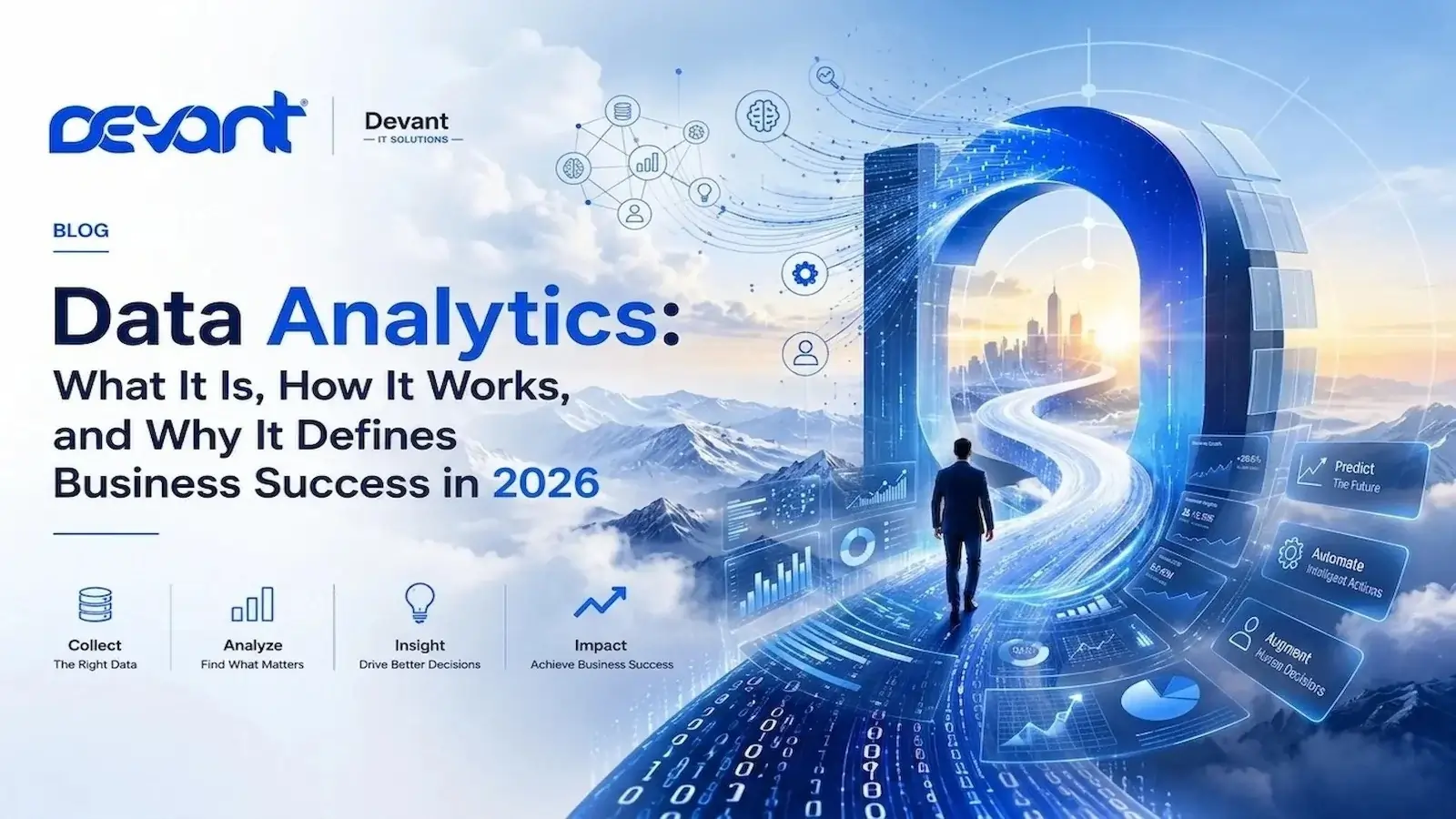
Data analytics has become a key driver of business success in 2026, helping organizations make smarter decisions, improve efficiency, and stay competitive in a fast-changing digital world. Despite heavy investments in analytics technologies, many businesses still struggle to become truly data-driven because success depends not only on tools but also on strategy and execution. From AI-powered insights and predictive analytics to real-time reporting and automation, data analytics helps businesses identify opportunities, reduce risks, and improve customer experiences. At Devant IT Solutions, data analytics is approached as a complete business transformation strategy focused on delivering measurable growth and long-term value. This guide explains how data analytics works, the latest tools and trends shaping the industry, and how organizations can build effective analytics strategies for sustainable business success.
Data analytics is the disciplined process of examining raw data - from structured databases, unstructured documents, and real-time feeds - to extract meaningful insights that support better decisions. It is the bridge between information and action.
It is worth distinguishing data analytics from related concepts. Data science is broader and more research-oriented - it involves developing new algorithms and advancing machine learning. Data analytics is more applied: it uses existing techniques to answer specific business questions. Business intelligence (BI) focuses primarily on historical data - what happened and when. Data analytics extends into the present and future: what is happening right now and what is likely to happen next.
Every analytics capability operates across four distinct layers. Most organisations have some version of the first. The most competitive have all four working together.
Descriptive Analytics - "What happened?"
Monthly sales reports, customer churn summaries, website traffic overviews. This layer is necessary but insufficient - it tells you what has already occurred, meaning your reaction is always after the fact.
Diagnostic Analytics - "Why did it happen?"
Root-cause analysis, correlation mapping, and drill-down exploration. A sales decline is a descriptive fact. Discovering that the decline was linked to a supplier failure that appeared in an unmonitored dataset three weeks earlier - that is diagnostic analytics working properly.
Predictive Analytics - "What will happen?"
Statistical models and machine learning that generate probabilistic forecasts, enabling proactive decisions. A retailer knows which products will spike in demand before the season arrives. A manufacturer knows which equipment is approaching failure before the line goes down. According to McKinsey, companies in the top quartile of analytics use are 19 times more likely to be profitable than those in the bottom quartile.
The most advanced layer - optimisation algorithms and AI agents that recommend specific actions: the optimal pricing strategy, ideal resource allocation, or the best customer intervention to reduce churn at scale. This is where AI is having its most dramatic impact in 2026 and where the largest untapped competitive advantage lies.
Data analytics has become essential for modern businesses to improve decision-making, enhance customer experiences, increase operational efficiency, and stay competitive. From personalized recommendations and predictive maintenance to fraud detection and marketing optimization, analytics helps organizations turn data into smarter business strategies and long-term growth.
One of the most consistent mistakes organisations make is treating tool selection as the primary decision in building analytics capability. The right tool matters, but it is secondary to having the right data infrastructure, governance, and people. With that caveat stated, here is an honest assessment.
Business Intelligence and Visualisation
Business Intelligence and visualisation tools help organizations transform complex data into clear insights and interactive reports. Microsoft Power BI is widely used for AI-powered dashboards and reporting, Tableau is known for advanced visual storytelling and executive dashboards, while Google Looker ensures consistent KPI tracking and embedded analytics across teams.
Cloud Data Warehousing
Cloud data warehousing platforms help businesses store, manage, and analyze large volumes of data efficiently. Snowflake is popular for its scalability and multi-cloud support, Databricks combines data engineering with machine learning capabilities, and Microsoft Fabric offers an integrated platform for data analytics, warehousing, and business intelligence.
Programming Languages
Programming languages play a major role in modern data analytics. Python is the most widely used language for analytics and AI development because of its flexibility and powerful libraries. SQL remains essential for managing and querying databases, while R is commonly used in academic research, healthcare, and statistical analysis.
This is where the analytics landscape has undergone its most significant transformation in 2026. AI is no longer a feature added to analytics platforms - it is the architecture.

Agentic analytics is transforming traditional data analysis by allowing AI systems to continuously monitor data, detect patterns, and identify anomalies automatically. Instead of waiting for users to ask questions, these intelligent analytics agents proactively deliver insights and support faster, smarter business decisions.
AI agents are helping businesses automate complex tasks by monitoring sales pipelines, managing supply chains, and simplifying financial reporting. These intelligent systems analyze data in real time, identify risks or opportunities early, and improve decision-making speed and operational efficiency.
Natural language interfaces allow users to ask data-related questions in simple everyday language without technical knowledge or coding skills. AutoML platforms automate machine learning model creation, making predictive analytics more accessible for businesses without large data science teams.
Retail and E-Commerce
Data analytics helps retail and e-commerce businesses improve inventory management, predict customer demand, and deliver personalized shopping experiences. It also strengthens fraud detection systems by analyzing transactions in real time, reducing financial risks and improving customer satisfaction.
Data analytics is transforming financial services by improving credit risk assessment, fraud detection, and personalized financial solutions. Businesses now use alternative data sources and real-time analytics to make smarter lending decisions and offer usage-based insurance models based on customer behavior.
Data analytics and machine learning are transforming healthcare and life sciences by speeding up drug discovery, improving diagnostics, and reducing research failures. AI-powered models help researchers identify effective treatments faster, making healthcare innovation more efficient and accurate.
Data analytics helps manufacturing industries reduce equipment downtime through predictive maintenance and real-time monitoring. AI-powered systems analyze sensor data to detect faults early, while computer vision technology improves quality control by inspecting products faster and more accurately than manual processes.
Closed-Loop Decision Intelligence -
Every decision becomes a data event - captured, labelled with its outcome, and returned as a new training signal. The analytics pipeline stops being a reporting mechanism and becomes a learning system. Accuracy compounds over time.
Data Mesh Adoption -
Organizations are increasingly adopting data mesh architecture, where data ownership is distributed across different teams instead of being managed by a single centralized unit. This approach improves scalability, flexibility, and faster decision-making across businesses.
Synthetic Data Growth -
Synthetic data is increasingly used for AI training while protecting sensitive information and privacy.
Responsible AI Governance -
Businesses are focusing more on AI transparency, compliance, and ethical data practices.
Real-Time Analytics -
Companies are using live data streaming to make faster and smarter business decisions.
Natural Language Analytics -
Conversational AI interfaces are making data analytics easier for non-technical users through simple language queries.

Start With Business Questions, Not Data Inventories
A successful analytics strategy should begin with important business questions rather than simply collecting data. Organizations need to identify decisions that can be improved through better insights, such as pricing, customer targeting, inventory management, and risk assessment. Focusing on business goals first helps companies use data more effectively and make faster, smarter decisions.
Before investing in analytics tools, organizations must ensure their data is complete, accurate, and consistent across all systems. Even the best analytics platforms cannot deliver reliable insights from poor-quality data. A proper data audit helps identify gaps and improves the effectiveness of future analytics strategies.
Analytics tools are only valuable when people actively use them. Businesses should integrate analytics directly into existing workflows and systems so employees can access insights easily without switching between multiple platforms. Simple and accessible analytics solutions improve adoption, decision-making, and overall business efficiency.
The success of data analytics should be measured by business results rather than the number of dashboards or reports created. Organizations should focus on improvements in decision-making, revenue growth, operational efficiency, risk reduction, and customer satisfaction achieved through data-driven insights.
Strong data governance is essential for reliable analytics and long-term business success. Organizations should establish clear data ownership, quality standards, and access controls from the beginning to ensure consistency, security, and trust in their data systems.
We are at an inflection point. The technology has matured to the point where the question is no longer "is this possible?" but "are we building the right foundation to capture the value it creates?"
The organisations widening their advantage are those that treated data architecture as a strategic decision from the beginning - that built governance into their pipelines rather than bolting it on later, matched tools to their teams' actual capabilities, and measured success by business outcomes rather than dashboard counts.
The global data analytics market is approaching half a trillion dollars by the end of this decade. The window for building a genuine analytics advantage is still open. But in every market, it is narrowing.
Ready to turn your data into meaningful business outcomes? Let’s explore where your organisation stands today and uncover the opportunities ahead. We focus on practical, results-driven analytics strategies that go beyond tools and deliver real impact. Whether you're starting your data journey or scaling AI-driven capabilities, the right direction makes all the difference. Get clarity, confidence, and a roadmap tailored to your goals.Get in touch to start the conversation with Devant IT Solutions.