
If you run a business in India and have ever wondered why some websites show up on the first page of Google while others stay buried several pages down, the answer almost always comes down to SEO. At Devant IT Solutions, this is a question we help clients answer every day, and it usually comes back to two very different kinds of work: on-page SEO and off-page SEO. Understanding on-page vs off-page SEO is one of the first steps toward building a website that actually gets found by the people who need it.
This guide breaks down both sides in plain, everyday language. Whether you are a small business owner trying to get more customers, a student learning digital marketing, or a working professional brushing up on the basics, you will walk away with a clear, practical understanding of how search engines think and what you can do about it.
SEO, or Search Engine Optimisation, is simply the practice of making your website easier for search engines like Google to understand, trust, and recommend to people searching online. When your SEO is done well, your website appears higher in search results for the terms your potential customers are actually typing in.
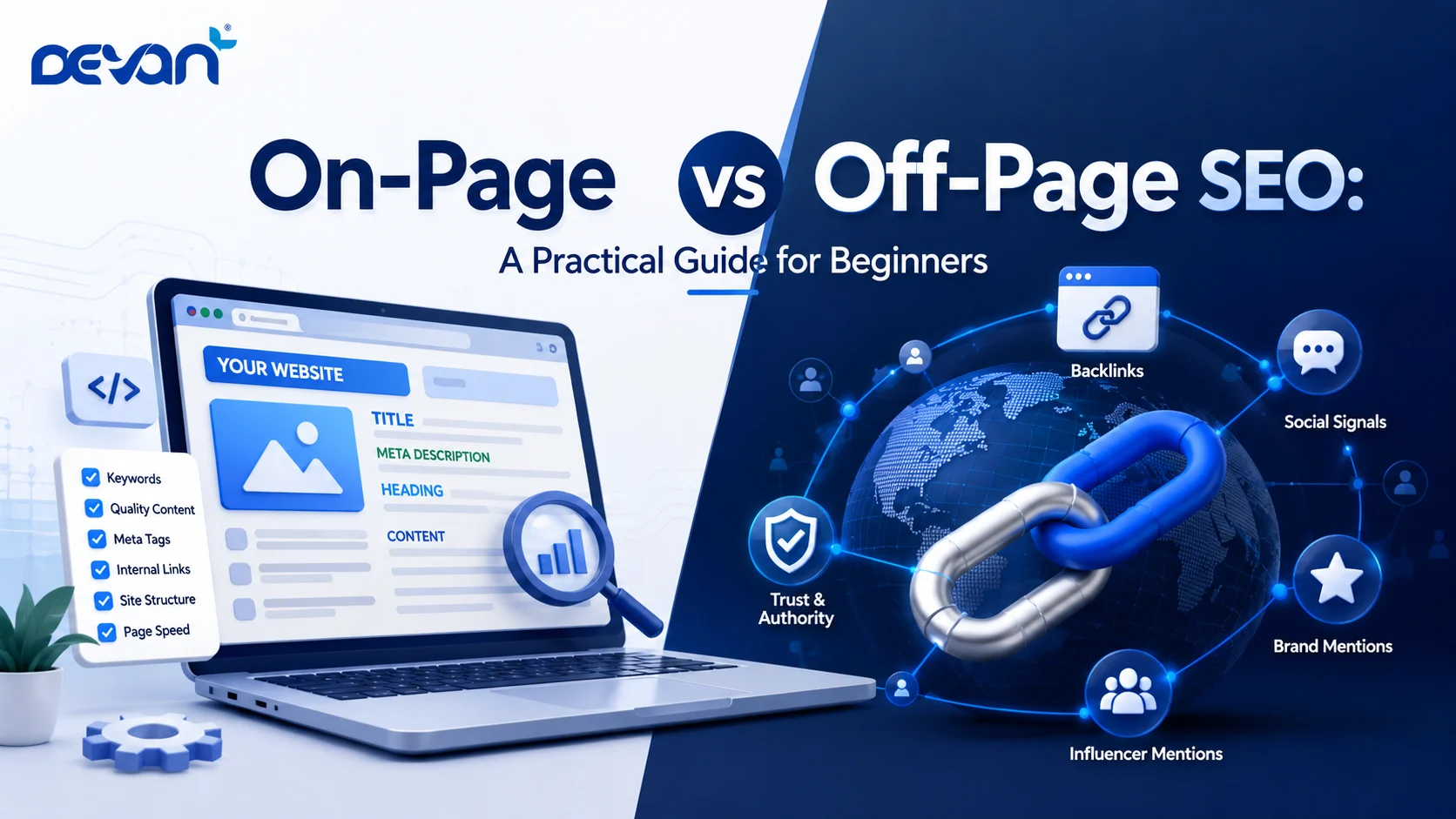
Now, here is where the on-page vs off-page distinction becomes important. On-page SEO refers to everything you control directly on your own website, such as your content, your page structure, and your technical setup. Off-page SEO, on the other hand, refers to signals that happen outside your website, such as other sites linking back to you or people talking about your brand online.
This distinction matters enormously for businesses in India today. The competition for visibility has grown sharply across almost every industry. A business that only focuses on one half of SEO, while ignoring the other, is essentially fighting with one hand tied behind its back.
The good news is that once you understand how the two work together, SEO stops feeling mysterious and starts feeling like a manageable, ongoing project. Let us start with on-page SEO, since it is usually the easier place for beginners to begin.
On-page SEO covers every optimization you make directly on your website to help both search engines and human visitors understand what your page is about. It is called "on-page" because it lives entirely within the pages you control. Getting comfortable with these on-page SEO techniques is often the fastest way for a beginner to see real improvement.
At the heart of on-page SEO is the quality of your content. Search engines are designed to reward pages that genuinely answer a visitor's question or solve their problem, not pages that are stuffed with words just to look impressive. Well-written, useful, and honest content will almost always outperform content that feels thin or copied.
For an Indian business, this might mean writing about the specific problems your local customers face, using examples they can relate to, and answering the exact questions they type into Google. The more genuinely helpful your page is, the more likely search engines are to trust it.
Keywords are simply the words and phrases people type when searching for something. If you run a landscaping business, for example, your customers might search for terms like garden maintenance services or terrace gardening ideas. Using these phrases naturally within your content helps search engines match your page to the right searches.
The key word here is naturally. Repeating a keyword over and over in an unnatural way, a practice often called keyword stuffing, actually hurts your rankings rather than helping them. A good rule of thumb is to write for your reader first, and let the keywords fit in where they make sense.
Meta tags are small pieces of text that describe your page to search engines, and the two most important ones are the title tag and the meta description. The title tag is the blue clickable headline you see in search results, while the meta description is the short summary underneath it.
Both should be clear, honest, and inviting. A well-written title and description will not just help your rankings, they will also encourage more people to actually click through to your website once they see it in the results.
Headings, such as the H1, H2, and H3 tags used throughout this very article, help organise your content into logical sections. They make your page easier for visitors to skim, and they also help search engines understand the structure and main topics of your content.
A page with one clear H1 title and a handful of well-organised H2 and H3 subheadings is far easier to read, and far easier for Google to crawl, than a page that is just one long, unbroken block of text.
Internal linking simply means linking from one page on your website to another relevant page on the same website. For instance, a blog post about home gardening tips might link to a service page about garden design.
This helps visitors discover more of your content, keeps them on your site longer, and helps search engines understand how different pages on your website relate to one another. It is one of the simplest on-page SEO techniques, yet it is often overlooked by beginners.
Page speed refers to how quickly your website loads for a visitor. A slow-loading site frustrates users, increases the chances they'll leave before the page even finishes loading, and can quietly hurt your search rankings over time. Google evaluates this through three core factors: loading speed, interactivity, and visual stability.
For businesses in India, where many visitors browse on mobile data connections that are not always fast, keeping your website light and quick to load is not just a technical nicety, it is often the difference between keeping a visitor and losing one.
With the overwhelming majority of Indian internet users browsing primarily on smartphones, having a website that works beautifully on mobile is no longer optional. Google evaluates websites based on their mobile-friendliness, meaning a site that looks cramped, has tiny unreadable text, or requires constant pinching and zooming will struggle to rank well, no matter how good the content is.
A mobile-friendly design also tends to lead to happier visitors, longer time spent on your site, and ultimately more enquiries or sales for your business.

If on-page SEO is about perfecting what happens on your own website, off-page SEO is about building trust and credibility everywhere else on the internet. Search engines do not just want to know what your website says about itself, they also want to know what the rest of the internet thinks of you. This is where off-page SEO strategies in India become especially important, since trust and word of mouth have always played a huge role in how Indian customers make decisions.
A backlink is simply a link from another website pointing back to yours. When a respected website links to your page, it acts almost like a vote of confidence, telling search engines that your content is valuable enough for someone else to reference.
Not all backlinks are equal, though. A link from a well-established, relevant website carries far more weight than dozens of links from low-quality or unrelated sites. For beginners, the safest approach is to earn backlinks naturally by creating content genuinely worth linking to, rather than chasing shortcuts.
Domain authority is a way of describing how trustworthy and established a website appears to be, based largely on the quality and quantity of backlinks it has earned over time. While it is not an official Google ranking factor by name, it is a useful concept for understanding why some websites seem to rank easily while newer sites have to work harder.
Building domain authority is a gradual process. It grows as your website earns more quality backlinks, builds a longer track record, and consistently publishes content that people find valuable enough to reference and share.
Social signals refer to the shares, likes, comments, and general engagement your content receives on social media platforms. While their direct impact on search rankings is debated, there is no doubt that an active social media presence helps your content reach more people, which in turn increases the chances of earning backlinks and brand mentions.
For Indian businesses, platforms like Instagram, Facebook, and LinkedIn are often where potential customers first discover a brand, long before they ever search for it directly on Google.
A brand mention happens whenever your business name is mentioned online, whether or not it includes a clickable link back to your site. Search engines are increasingly able to recognise these mentions as a signal of credibility and popularity, especially when they come from reputable sources.
Getting featured in local news articles, industry blogs, or community discussions, even without a direct link, can quietly strengthen how search engines and potential customers perceive your brand.
Your online reputation includes reviews, ratings, and the general sentiment people express about your business across the internet. Positive reviews on platforms like Google Business Profile can significantly influence both your local search rankings and a potential customer's decision to trust you.
For many Indian businesses, especially those serving local customers such as clinics, schools, restaurants, or service providers, online reputation can be just as influential as any technical SEO factor, since people naturally trust the experiences of others like them.

It is tempting to think of on-page vs off-page SEO as a choice between two competing strategies, but in reality, the two work best as partners rather than alternatives. On-page SEO builds the strong, trustworthy foundation of your website, while off-page SEO builds the reputation and authority that convinces search engines your website deserves to be seen.
Think of it this way. On-page SEO is like renovating and organising a shop so that everything inside is clean, clearly labelled, and easy to navigate. Off-page SEO is like earning a strong reputation in the neighbourhood, so that people recommend your shop to their friends and family even before they have walked inside.
A website with excellent content and technical setup, but no backlinks or online presence, will struggle to be discovered, because search engines have little external evidence that it deserves attention. On the flip side, a website with plenty of backlinks but poor, thin content will struggle to keep visitors once they arrive, and search engines will eventually notice that too.
The businesses that succeed with SEO for beginners and beyond are the ones that treat both sides as ongoing, connected efforts. Strong on-page work makes your off-page efforts more effective, since quality content is what earns natural backlinks and mentions in the first place. And strong off-page signals make your on-page work more visible, since higher authority often leads to better rankings for the same content.
One of the most common mistakes beginners make is writing content for search engines instead of for people, cramming in keywords until the writing feels robotic and unnatural. Another frequent issue is ignoring page speed and mobile design entirely, assuming that good content alone is enough, when in fact a slow or clunky website can undo even the best writing.
Many beginners also forget about meta tags altogether, leaving titles and descriptions to be automatically generated, which often results in confusing or unappealing snippets in search results. Skipping internal linking is another easy trap, since it is a simple technique that gets overlooked simply because it is not as visible as writing a new blog post.
On the off-page side, one of the biggest mistakes is chasing large numbers of low-quality backlinks quickly, rather than earning fewer, higher-quality links over time. This approach can look suspicious to search engines and may do more harm than good in the long run.
Ignoring online reviews and reputation management is another common oversight, especially among businesses that assume SEO is purely a technical, website-based task. Similarly, treating social media as a separate, disconnected activity rather than part of the same overall SEO strategy often means missing out on valuable brand visibility and engagement.
SEO does not have to feel overwhelming once you break it down into its two natural halves. On-page SEO gives you control over your own website, from the words you write to how quickly your pages load, while off-page SEO builds the trust and reputation that convinces the wider internet, and search engines, that your business deserves attention.
The real secret behind on-page vs off-page SEO is that it was never meant to be a competition between the two. The businesses that grow steadily online are the ones that invest in both, consistently and patiently, over time. If you are just starting out, begin with the on-page basics covered here, and gradually build your off-page presence as your content and reputation grow. And if you would rather have experienced hands guide the process, Devant IT Solutions is always happy to help.
What is the main difference between on-page and off-page SEO?
On-page SEO covers everything you control directly on your website, such as content, meta tags, and page speed. Off-page SEO covers external signals like backlinks, brand mentions, and online reviews that build trust beyond your own site.
Which is more important for beginners, on-page or off-page SEO?
Most experts suggest starting with on-page SEO, since it forms the foundation everything else builds on. Once your website is well-structured and your content is strong, off-page efforts tend to be far more effective.
How long does it take to see results from SEO?
SEO is a gradual process, and most businesses start noticing meaningful improvement over several months rather than days or weeks. Consistency matters more than speed.
Can a small business in India really compete using SEO?
Yes, absolutely. Many small and local businesses in India rank well by focusing on relevant, honest content and building a genuine local reputation, rather than trying to compete on a national scale.
Do I need to hire an agency, or can I do SEO myself?
Many of the basics covered in this guide can be handled by a beginner with some patience and consistency. As your website grows and competition increases, working with experienced professionals, such as the team at Devant IT Solutions, can help you move faster and avoid common mistakes.
Have questions about your website's SEO or want to explore how Devant IT Solutions can support your growth online? Reach out to us anytime, and our team will be happy to walk you through the next steps in a simple, jargon-free conversation.
Want more simple, practical tips like these delivered regularly? Follow Devant IT Solutions on our social media channels, where we share easy-to-understand insights on SEO, digital marketing, and growing your business online. It is a great way to stay updated without the jargon.