
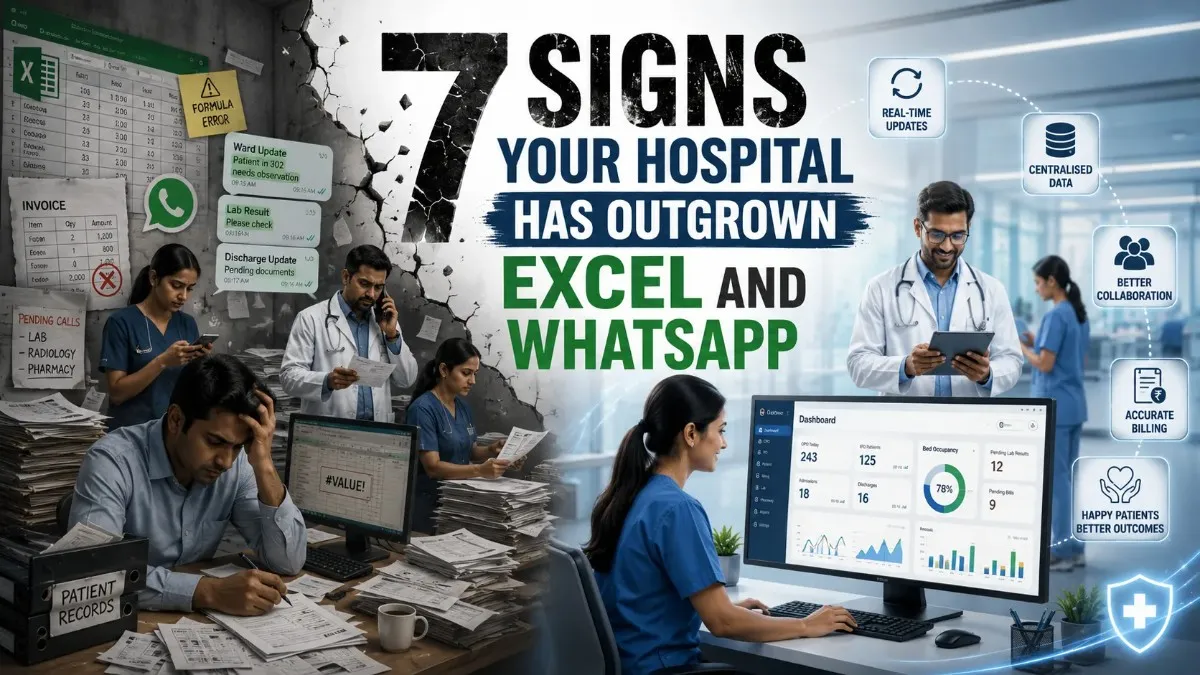
Picture this. It is a busy Tuesday morning at your hospital. The OPD queue is growing, the pharmacist is waiting on a lab result, and your billing executive is cross-checking a patient's invoice against a printed Excel sheet from last week. Meanwhile, the ward nurse has sent an update on WhatsApp, but the concerned doctor is in a consultation and has not seen it yet. A patient's discharge is delayed. A family is frustrated. And somewhere in the background, a formula error in a spreadsheet has already made two invoices incorrect.
If this sounds familiar, you are not alone. Thousands of hospitals and clinics across India are running their operations on a combination of Excel sheets, WhatsApp groups, paper registers, and manual phone calls. It worked fine when you had twenty beds and a small team. But as your hospital grows, these tools start cracking under the pressure.
This is not about blaming anyone. Excel and WhatsApp were never designed for healthcare operations. They are general-purpose tools doing a specialist's job - and they are showing it. The question is: how do you know when it is time to move on? Here are seven clear signs that your hospital has outgrown these informal tools, and what a proper Hospital Management System India - like the one developed by Devant IT Solutions - can do to bring order back to your operations.
When billing is managed manually - through spreadsheets, handwritten tallies, or disconnected software - errors are almost inevitable. A discount that was applied twice. A procedure charge that got missed. A medicine that was dispensed but never billed. These are not careless mistakes; they are the natural result of a manual system where data flows from one person to another through memory, paper slips, and messaging apps.
The financial impact adds up fast. Missed charges directly reduce your revenue. Over-billing, even when accidental, damages patient trust. And reconciling accounts at month-end becomes a forensic exercise that pulls your finance team away from productive work.
HMS software for hospitals resolves this at the root level. Every service, procedure, investigation, and medicine consumed is automatically linked to the patient's account in real time. By the time the patient reaches discharge, the final bill is already consolidated, verified, and ready. There are no missing entries. No double-counts. No awkward conversations with patients over errors.
How does your front desk manage doctor appointments today? If the answer involves a paper diary, an Excel sheet, or a WhatsApp message to the doctor's personal number, you are losing time and patients every single day. Double bookings, long wait times, missed follow-up reminders, and patients who simply gave up and went elsewhere - these are the hidden costs of an unstructured appointment system.
As patient volumes grow, the complexity multiplies. You have multiple doctors, multiple OPD timings, surgery schedules, ICU rounds, and outpatient consultations all happening in parallel. Keeping that coordinated through informal tools is genuinely exhausting for your front desk staff, and the patient experience suffers.
A healthcare management system gives your hospital a proper appointment engine - one that shows real-time doctor availability, books slots accurately, sends automated reminders to patients via SMS or WhatsApp, and flags no-shows so that vacant slots can be filled. What currently takes your receptionist twenty minutes of back-and-forth can be handled in under two minutes.
If your doctors are sending lab orders through WhatsApp and pharmacy requests through phone calls, your hospital has a serious workflow problem - even if it does not feel like one yet. When communication channels are informal, things get missed. A lab request sent late in the shift. A prescription photo that did not load properly. A result shared in the wrong group.
These are not just inconveniences. In a clinical setting, delays in lab results or medication delivery can affect patient outcomes. And when something does go wrong, there is no structured audit trail to understand what happened or when.
With hospital management software India, lab orders and pharmacy requests flow directly from the doctor's workstation to the respective department the moment they are entered. Results come back into the system automatically, and the treating doctor is notified in real time. No phone calls. No forwarded screenshots. Just a clean, traceable workflow that moves as fast as your patients need it to.
A returning patient walks into your OPD. They were admitted six months ago, had surgery, and are now back for a follow-up. Your staff searches the register, checks a folder, asks someone to look through last year's Excel files, and ultimately spends eight minutes trying to piece together the patient's history. The doctor starts the consultation without the complete picture.
This is an extremely common scenario in hospitals that rely on paper records or disconnected digital files. Patient records are split across physical files, scanned PDFs on individual computers, discharge summaries in one folder, lab reports in another. For chronic patients or those with complex medical histories, this is a genuine clinical risk - not just an administrative inconvenience.
A Hospital Management System India maintains a unified electronic health record for every patient from their very first visit. Admission notes, investigation reports, prescription history, discharge summaries, and doctor observations are all stored in one place and accessible in seconds. Your clinical team gets the full picture before they even say hello to the patient.
WhatsApp is a wonderful messaging tool for staying in touch with family and friends. For clinical teams managing patient care, it is alarmingly inadequate. Messages get buried under unrelated conversations. Critical updates go unread because notifications are muted. There is no way to confirm who saw what, or when. And in a hospital, that ambiguity is a liability.
Beyond patient care, staff coordination - duty rosters, leave requests, task assignments, escalation protocols - all suffer when handled informally. When a nurse does not know if a supervisor saw her update, or a ward boy is not sure which bed to prepare because the admission message came in a group with forty people, small inefficiencies compound into big problems.
Digital transformation in Indian hospitals means creating structured workflows where every task, update, and handover happens inside the system and is automatically recorded. Duty schedules are visible to the right people. Patient care updates go directly to the relevant clinician. Escalations are flagged and tracked. Nobody falls through the cracks because a message got lost in a busy group chat.

If your hospital administrator or accounts team spends several days at the end of every month compiling reports - cross-referencing spreadsheets, manually tallying OPD visits, preparing MIS summaries, or generating data for audits - that time is being wasted on work that a system should be doing automatically.
India's healthcare landscape comes with real compliance obligations. Whether it is NABH documentation, tax filings, insurance claims, or internal board reporting, data needs to be accurate, structured, and ready on demand. When your data lives in fifteen different Excel files maintained by five different people, preparing a reliable report is a project in itself.
A healthcare management system generates accurate reports on demand - daily, weekly, monthly - with data that is already structured and verified. Occupancy rates, revenue by department, doctor-wise patient load, pharmacy consumption, and discharge statistics are all available in a few clicks. What used to take your team three days now takes three minutes.
Revenue leakage in hospitals is often invisible until someone looks closely. Procedures not billed. Medicines dispensed but not recorded. Surgeon fees calculated incorrectly. Package rates applied inconsistently. Insurance claims rejected because the documentation was incomplete. When your operations run on disconnected manual systems, these leaks are nearly impossible to detect in real time.
Most hospital owners are surprised when, after switching to a proper HMS, they discover how much revenue was quietly slipping away each month. It is not because of bad intent - it is because manual systems have no mechanism to flag what is missing. There is no alert for an unbilled procedure. No report that shows which packages are being applied incorrectly. No dashboard that flags a claim likely to be rejected.
HMS software for hospitals closes these leaks by automating the connection between clinical services and billing. Every item is tracked from the point of order to the point of billing. Package inclusions and exclusions are enforced by the system, not by memory. Insurance documentation is collected as part of the workflow, not chased at the last minute. Your revenue protects itself.
All seven signs above point to one underlying truth: informal tools create informal systems, and informal systems cannot scale. The good news is that the shift to a Hospital Management System India is not as complicated or disruptive as many administrators fear.
A modern HMS brings all your hospital's functions - OPD, IPD, pharmacy, lab, billing, HR, stores, and reports - into a single integrated platform. Information entered at one point flows automatically to every department that needs it. There are no manual transfers, no duplicate entries, and no version confusion. Everyone is working from the same live data at the same time.
Think about how much of your staff's day goes into tasks that are repetitive and mechanical - generating bills, updating stock, sending reminders, preparing shift reports. Automation handles all of this silently in the background, freeing your people to focus on work that actually requires a human being. Patient reminders go out automatically. Stock alerts are triggered before items run out. End-of-day reports generate themselves.
One of the most immediate changes hospital administrators notice after implementing HMS is the quality of information they have access to. Instead of waiting for a weekly summary or hunting through spreadsheets, a real-time dashboard shows you bed occupancy, today's revenue, pending lab reports, and department-wise performance - all at a glance, from any device. Good decisions start with good information, and good information starts with a system that keeps it current.
The reason Excel and WhatsApp eventually fail is that they are isolated tools - they do not connect to each other or to your data in any meaningful way. A proper healthcare management system is built around integration. When a doctor prescribes a medicine, the pharmacy knows immediately. When a lab result is ready, it appears in the patient's record and notifies the treating team. When a patient is discharged, billing closes automatically. The system works as one unit, not as a collection of disconnected parts.

Absolutely. HMS solutions today are designed to scale - which means they work just as well for a 30-bed clinic as they do for a 300-bed multi-specialty hospital. In fact, smaller facilities often see the most dramatic improvements because the gap between what informal tools can handle and what a system can do is enormous at that scale.
Implementation timelines vary based on the size of your facility and the number of modules involved. For a standard setup, most hospitals are up and running within a few weeks. Staff training is built into the onboarding process, so your team is not left to figure things out on their own. The transition is designed to be smooth, not disruptive.
Data migration is a standard part of any HMS implementation. Your existing patient records, billing history, and other relevant data are migrated into the new system before it goes live. Nothing is lost in the transition. The new system picks up exactly where your old records left off.
This is one of the most common concerns, and it is completely understandable. Modern HMS interfaces are built for ease of use - they look and feel more like an app than a complicated enterprise system. Most staff members are comfortable navigating the system within a week of training. The goal is to make their work easier, not harder, and the design reflects that.
Managing a hospital is one of the most demanding operational challenges there is. When your tools are not built for the scale and complexity of modern healthcare, every day becomes harder than it needs to be. If you recognised your hospital in any of the seven signs above, that recognition is the first step toward fixing it.
The shift from spreadsheets and messaging apps to a proper Hospital Management System India is not just a technology upgrade - it is a structural change that affects every department, every patient, and every rupee that flows through your facility. It is how hospitals move from surviving to truly running well.
Digital transformation in Indian hospitals is no longer a future trend. It is already happening - and the hospitals investing in the right systems today are the ones building the reputation and operational strength that will carry them forward for years to come.
If you are exploring HMS solutions for your hospital or clinic, we would love to have that conversation with you. We work with healthcare facilities across India to understand their specific challenges and implement systems that genuinely make a difference. Reach out to us today - no pressure, no hard sell, just a straightforward discussion about what your hospital needs and how we can help.