
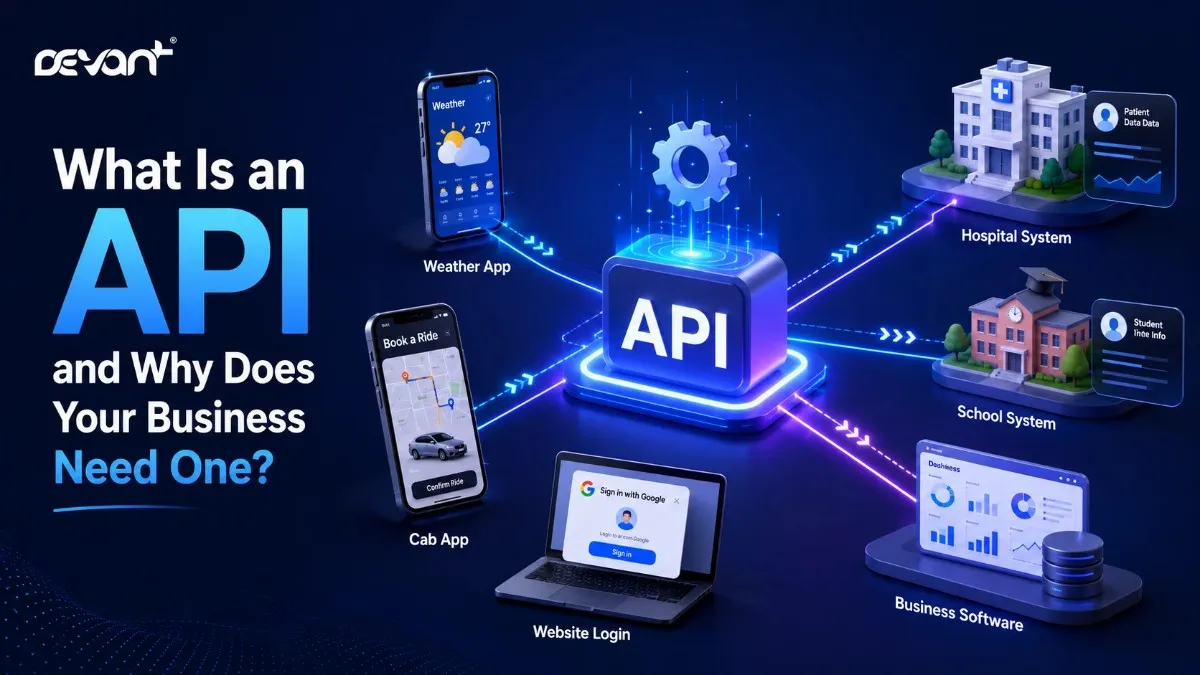
If you have ever used a mobile app to book a cab, checked the weather on your phone, or logged into a website using your Google account, you have already experienced an API in action - you just did not know it. APIs are quietly running in the background of almost every digital experience we have today. They are the connectors, the translators, the silent workers that make modern software feel seamless and effortless.
But what exactly is an API? And more importantly, why should your business care about it? Whether you run a school, a hospital, a small startup, or a large enterprise, understanding APIs can genuinely change how you think about your technology and your growth. At Devant IT Solutions, we build management systems for schools, colleges, and hospitals that are powered by exactly this kind of smart, connected technology - and we believe every business owner deserves to understand the tools shaping their digital future. In this blog, we will explain everything from scratch, in plain language, so that you walk away feeling confident about what an API is and why it matters.
API stands for Application Programming Interface. If that sounds technical, do not worry - we are about to make it very clear.
Think of an API like a waiter in a restaurant. You, the customer, sit at your table. The kitchen is in the back, and that is where the food is prepared. You do not walk into the kitchen and cook your own meal. Instead, you tell the waiter what you want, the waiter goes to the kitchen with your order, and then brings back exactly what you asked for.
In the digital world, you are the user or the application. The kitchen is the server or database. And the API is the waiter - the messenger that takes your request, delivers it to the right place, and returns with a response.
In short, an API is a set of rules and protocols that allows two software applications to talk to each other. It defines how requests should be made, what data can be accessed, and how the response will be returned.
For example, when you use a flight booking app and it shows you seat availability from multiple airlines in real time, it is using airline APIs to fetch that data instantly. When a hospital management system sends a patient's report to a doctor's app, an API is making that transfer possible.
Every time an API is used, a simple cycle plays out in milliseconds. A request is sent, it gets processed, and a response comes back. Here is how that works in three steps.
Your application sends a request to an API endpoint. Think of an endpoint as a specific address where the API lives. The request says: here is what I need, here is who I am, and here is the format I want the answer in.
The API receives the request and passes it to the right system - a database, a third-party service, or a server-side function. It checks whether the request is valid, authenticates the caller if needed, and then fetches or processes the required data.
Once the data is ready, the API sends it back in a structured format - usually JSON or XML. Your application receives this response and uses it to display information, trigger an action, or update a record.
This entire exchange often happens in under a second. That speed and reliability is what makes APIs so powerful in modern business systems.
Not all APIs are the same. Different types of APIs serve different purposes, and knowing the difference helps you make smarter technology decisions.
These are available to any developer or business and are typically offered by platforms to encourage third-party integrations. They allow you to connect your system with widely used services like payment gateways, map providers, or communication platforms.
Private APIs are used within an organisation. They connect internal systems - for example, linking a company's HR software with its attendance tracking system. They are not exposed to the outside world and help different internal tools communicate efficiently.
Partner APIs are shared between specific business partners. For instance, a logistics company might give a retail partner access to its tracking API so that the retailer can show delivery updates to customers in real time.
These combine multiple API calls into one single request. Instead of asking several systems for data one by one, a composite API bundles everything together and delivers a complete, unified response. This is particularly useful in microservices-based architectures.

The business world is moving faster than ever. Customers expect real-time information. Teams need tools that talk to each other. And companies that cannot keep up with this pace of digital interaction risk falling behind. APIs are how businesses stay connected, agile, and competitive.
Most businesses today use multiple software tools - a CRM, an accounting system, a communication platform, a management dashboard. Without APIs, each of these tools lives in its own silo. Data has to be entered manually, reports have to be exported and imported, and mistakes happen constantly.
With APIs, your tools connect automatically. Your sales team's data updates your accounting software. Your school management system syncs with your communication platform. Everything talks to everything, without anyone manually copying data from one screen to another.
In today's world, decisions cannot wait. A hospital administrator needs to see bed availability right now. A school principal needs to track attendance in real time. A business owner needs to see today's revenue figures, not last week's. APIs make real-time data flow possible by continuously syncing information across connected systems.
When your business grows, your software needs to grow with it. APIs let you add new functionality without rebuilding your entire system. You want to add an online payment option to your existing management system? Connect a payment API. You want to send automated SMS notifications? Add an SMS API. Growth becomes modular and manageable.
Customers interact with APIs without knowing it. When they book an appointment on your website and instantly receive a confirmation email, that is an API at work. When they log in with a single click using their existing account on another platform, that is API authentication. APIs make digital experiences fast, smooth, and satisfying - and that directly affects how customers feel about your brand.
Many businesses have turned their APIs into products. By offering your data or services through an API, you can create a new channel for partnerships and integrations. Other businesses pay to access your API, or you can build premium integrations that add value and justify higher pricing tiers. In India, this model is growing rapidly across sectors like fintech, healthtech, and edtech.
India is in the middle of a massive digital transformation. With government initiatives pushing for paperless systems, universal digital identity, and open banking frameworks, APIs have become the backbone of this transformation.
The rise of API in India is evident across sectors. Banks and financial institutions use APIs to offer instant account verification, UPI integration, and digital lending. Hospitals and clinics use APIs to connect patient records, lab systems, and insurance portals. Schools and colleges use APIs to link admission portals, fee management systems, and communication tools. And businesses of every size are using APIs to automate workflows that once required entire teams.
For Indian companies, especially small and mid-sized businesses, APIs offer a way to access enterprise-grade capabilities without the cost of building everything from scratch. A school in a tier-2 city can connect its management system to a payment gateway, a communication tool, and a reporting dashboard - all through APIs, and all at a fraction of what custom development would cost a decade ago.
The growth of API in India is also being driven by the startup ecosystem. Thousands of Indian startups are building API-first products that other businesses can plug into easily. This creates a rich marketplace of digital services that Indian companies can leverage to build better, faster, and smarter systems.
APIs have always been powerful. But when you add artificial intelligence into the mix, they become transformational. AI-powered APIs and intelligent agents are now reshaping how Indian businesses handle data, make decisions, and automate entire workflows that once required significant human effort.
An AI API is essentially a gateway to a trained machine learning model or an intelligent service. Instead of building an AI system from scratch - which requires massive data, compute resources, and specialised expertise - businesses can simply call an AI API and get intelligent capabilities instantly.
These could include natural language understanding, image recognition, sentiment analysis, predictive analytics, or document processing. The AI does the heavy lifting; the API delivers the result cleanly to your application.
An AI agent is a software system that can take actions autonomously based on instructions and context. Think of it as a smart, proactive assistant that does not just respond to queries but actually does things on your behalf - sending emails, updating records, scheduling meetings, generating reports, or escalating issues.
When AI agents are connected through APIs, they can move across multiple systems, gather information, perform tasks, and return results - all without a human in the loop. This is what makes them so powerful for business automation.
Across India, businesses are beginning to embrace AI-driven automation in meaningful ways. In the education sector, AI APIs are being used to personalise learning paths for students, automate fee reminders, and analyse attendance patterns to flag at-risk students early. School management systems can now generate intelligent insights from raw data that administrators previously had to sift through manually.
In healthcare, AI-powered APIs are helping hospitals analyse patient data for early diagnosis support, automate appointment scheduling, and even flag billing anomalies before they become compliance issues. A hospital system that once required a team of data analysts can now surface daily insights automatically through an AI API layer.
In business intelligence and enterprise software, AI agents connected through APIs are monitoring dashboards, triggering alerts when key performance metrics shift, and automatically drafting summary reports for leadership. These agents do not sleep, do not miss patterns, and do not need to be reminded - they are always working.
Perhaps the most significant change that AI APIs bring to Indian businesses is the shift from reactive to proactive decision-making. Traditional software tells you what happened. AI-powered APIs tell you what is likely to happen and what you should do about it.
A business owner no longer has to wait for the monthly report to spot a problem. An AI agent connected through an API can surface that insight in real time, alert the right person, and even suggest a corrective action - all automatically.
This is not a distant future concept. It is happening today, in businesses of all sizes, across India. And it starts with having the right API infrastructure in place.

At Devant IT Solutions, we build management systems for schools, colleges, and hospitals that are designed from the ground up to be API-ready. Our School Management System, Hospital Management System, and College Management System are not isolated tools - they are connected platforms that integrate with the services your organisation already uses and the new capabilities you want to add.
Whether it is connecting your school system to a payment gateway, integrating your hospital platform with a lab reporting tool, or linking your college system to government portals, our API-first approach means your software grows with you rather than holding you back.
We also offer mobile application development and business intelligence solutions that are built on robust API architectures. This means the apps we build talk to your backend systems in real time, and the dashboards we create pull live data from every connected source - giving decision-makers the visibility they need, when they need it.
Our team works with technologies including Angular, React Native, Flutter, and PHP-Laravel, which means we can build API integrations that work across web platforms, Android, iOS, and enterprise backends - all within a single, cohesive system.
An API is not just a technical concept for developers. It is a business strategy. It is how organisations stay connected in a fragmented digital world. It is how data flows in real time between systems that were never meant to talk to each other. It is how AI is being woven into everyday business operations across India and the world.
Understanding what is an API and why does your business need one is the first step toward building a more integrated, automated, and intelligent operation. Whether you are running a school in West Bengal, a hospital in Tamil Nadu, or a startup in Bengaluru, APIs are the infrastructure that will power your next phase of growth.
The businesses that invest in API-driven architecture today are the ones that will have the most flexibility, the most data visibility, and the greatest ability to adapt tomorrow. The question is not whether you need an API strategy - the question is whether you are ready to build one.
At Devant IT Solutions, we are here to help you take that step. Explore our products, talk to our team, and let us build something that works - beautifully, reliably, and intelligently.
Q1. What is an API in simple terms?
An API, or Application Programming Interface, is a bridge that allows two software applications to communicate with each other. It lets one system send a request to another and receive a structured response - much like a waiter taking your order to the kitchen and bringing back your food.
Q2. Does a small business really need an API?
Yes, absolutely. Even small businesses benefit from APIs. If you want your website to accept payments, send automated emails, or display real-time data from another system, you are already using APIs. The question is whether those integrations are set up well and whether they are helping you grow efficiently.
Q3. What is the difference between an API and a website?
A website is designed for humans to read and interact with through a browser. An API is designed for machines and software to interact with programmatically. A website delivers HTML pages; an API delivers structured data. Both can serve the same information, but they serve very different audiences.
Q4. How is API being used in India specifically?
API in India is growing rapidly across sectors. Banks use APIs for UPI payments and digital KYC. Hospitals use APIs to connect patient records and insurance systems. Schools use APIs to sync management software with fee payment platforms and communication tools. Government systems use APIs to enable digital identity verification and service delivery.
Q5. What role do AI APIs play in business automation?
AI APIs give businesses access to intelligent capabilities - like natural language processing, predictive analytics, and image recognition - without building those systems from scratch. When combined with AI agents, these APIs can automate complex workflows, surface real-time insights, and help businesses make faster, smarter decisions.
Q6. How can Devant IT Solutions help with API integration?
Devant IT Solutions builds API-ready management systems for schools, hospitals, and colleges, along with mobile applications and business intelligence dashboards. Our systems are designed to integrate with your existing tools and future services, so your software grows with your organisation rather than becoming a limitation.
Have questions or ready to explore what the right technology can do for your organisation? We would love to hear from you. Reach out to the team at Devant IT Solutions through our website, drop us an email, or give us a call - we are always happy to help.
Stay updated with the latest insights on technology, management systems, and digital transformation by following Devant IT Solutions on LinkedIn, Instagram, and our other social channels. We regularly share tips, product updates, and industry news that are relevant to businesses and institutions across India. Join our growing community and stay ahead of the curve.